
Ownership and Maintenance
6 Common Mercedes-Benz Problems Every Owner Should Know
I'm Shawn Baker, an ASE Certified Master Technician and the founder of South Bay Luxury Motors in Torrance. I've spent years with Mercedes-Benz cars up on the lift, and the honest truth is this: they're excellent machines with a handful of well-known weak spots. Here are the six common Mercedes problems I see most, what causes them, and how to catch them before they turn into a big bill.
None of this is meant to scare you off the brand. I own the tools the dealer owns, I work on these cars every week, and I'd still recommend a Mercedes to anyone. Knowing the patterns just means you get to fix things on your terms instead of getting blindsided.
What are the most common Mercedes-Benz problems?
The most common Mercedes-Benz problems are air suspension faults, oil leaks, electrical gremlins, rust on older models, brake wear on performance cars, and a few specific engine issues. Every one of them is a documented pattern on certain model years, which means it can be watched for. Catching any of these early is the difference between a routine repair and an expensive one.
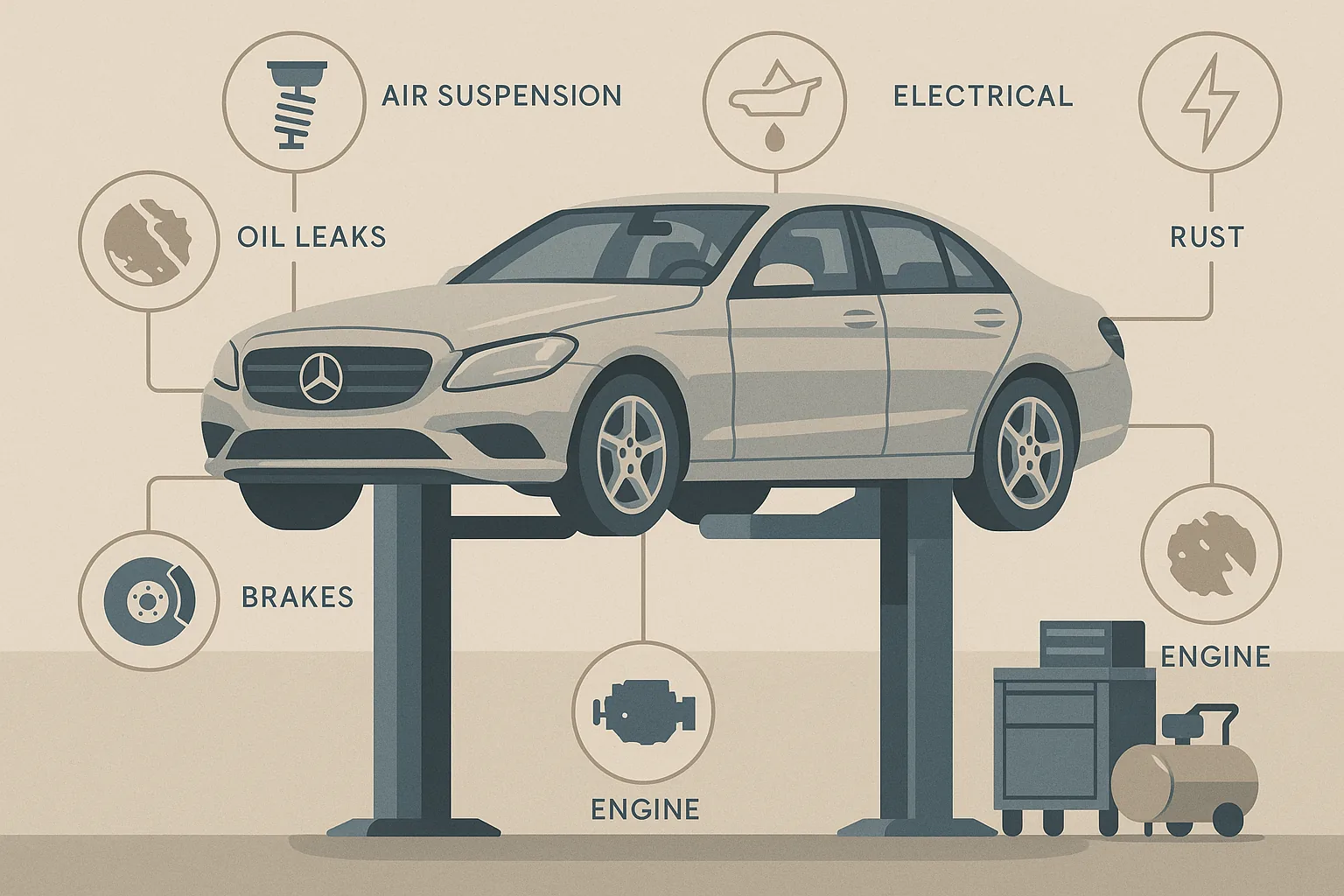
The six areas I check first on an older Mercedes. Which ones apply depends on your model and mileage.
Let me take them one at a time, in the order I tend to run into them.
1. Air suspension (AIRMATIC) faults
If your Mercedes rides on air suspension, this is the issue to know about first. AIRMATIC uses air springs and a compressor instead of conventional steel springs, and it gives that famous cushioned ride. It also has more parts that wear.
The usual symptoms are a car that sags on one corner overnight, a rear end that sits low, or a compressor that runs long and hard trying to keep up. The air struts and the compressor are the common failure points as the car ages. This shows up most on ML, GLE, GLS, and S-Class models.
Caught early, it's a defined repair. Ignored, a failing compressor can burn out chasing a leaking strut. If your Mercedes sits unevenly, our Mercedes suspension repair diagnoses the specific failed component instead of throwing parts at it.
2. Oil leaks from gaskets and seals
Oil leaks are the second thing I see, and they're age-related more than anything. The classic culprits are the valve-cover gasket and the oil-cooler seals, which harden over years of heat cycles and start to weep.
A small leak isn't an emergency, but it doesn't fix itself either. Left alone, oil drips onto hot exhaust and creates that burning smell, or it slowly drops your level until the engine is running low. Both are avoidable with an early gasket job.
The signs are easy to spot: a burning-oil smell after you park, spots on the driveway, or a low reading on the dipstick. Our Mercedes oil leak repair pinpoints exactly which gasket is leaking, because "it leaks oil" can mean five different things on these cars.
3. Electrical and control-module gremlins
Modern Mercedes-Benz cars run dozens of control modules that talk to each other over a network, and when one gets confused, the symptoms can be strange. A window that quits, a warning light with no obvious cause, a door lock that acts up, or a car that won't start on a cold morning.
This is where a proper scan matters most. Guessing at electrical faults is how people end up replacing three parts to fix one problem. The right approach is to read the actual fault codes across every module and trace the cause.
That's exactly what dealer-level tools are for. Our Mercedes electrical diagnostics use the same tier of equipment the dealer uses to find the real fault, so you pay to fix the problem, not to guess at it.

How the six problems tend to scale in cost. The gap between "caught early" and "ignored" is where the money is.
4. Rust on older models
Rust is mostly a concern on older Mercedes, particularly the W210 E-Class (mid-1990s to early 2000s) and some W211-era cars, which had documented corrosion issues from the factory paint process of that period. It's less of a problem on newer cars.
Out here in the South Bay we're luckier than the salt-belt states, but coastal air and older paint still let rust start at the usual spots: rear wheel arches, the lower doors, around the trunk lid, and the jack points. Once it starts under the paint, it spreads quietly.
If you own an older Mercedes, check those areas yourself once a year, or have them looked at during service. The earlier surface rust is treated, the less it costs. A pre-purchase inspection is also worth its weight before you buy an older W210 or W211.
5. Brake wear on AMG and performance models
Mercedes brakes are engineered well, but the AMG and performance cars use larger, higher-spec pads and rotors that wear on their own schedule and cost more than the standard line. That's not a defect; it's the price of the braking those cars are built to do.
Add South Bay traffic to the mix and pads wear faster than a highway-cruise interval would suggest. Stop-and-go on the 405 is hard on any brake, and harder on a heavy performance car.
The tell is a squeal, a shimmy under braking, or a pedal that feels longer than it used to. When your Mercedes needs pads or rotors, our Mercedes brake repair uses the correct compound and rotor spec for your specific model, not whatever's cheapest on the shelf.
6. Engine issues on specific model years
A few Mercedes engines have known issues tied to specific years, and it pays to know whether yours is one of them. The most famous is the balance-shaft and idle-gear wear on some M272 V6 and M273 V8 engines built roughly between 2004 and 2008, which can throw a check-engine light for camshaft timing.
The other pattern is cooling and timing components made partly of plastic that get brittle with age, along with the same gasket weeps I mentioned earlier. A rough idle, a timing-related code, or a cooling warning are all worth a proper look.
The right first step is always diagnosis, not parts. A Mercedes engine diagnostic with the correct tools tells us whether you're looking at the balance-shaft issue, a sensor, or something minor, so you spend money on the actual fault.
If your Mercedes is older or you're shopping for a used one, ask which engine it has and whether it falls in that 2004 to 2008 window. It doesn't mean you should walk away. It means you go in with your eyes open and factor it into the price.
How do I stay ahead of these problems?
The short answer: inspect on schedule and catch the known items early. Most of these six problems are cheap when they're small and expensive when they're ignored, so the yearly checkup is where the real savings live.
Three habits do most of the work. Keep up with scheduled service to spec, so oil and fluids are always fresh. Have the known trouble spots looked at once a year based on your model. And when something feels off, get a real diagnosis instead of guessing.
That last habit is the whole point of an independent specialist. South Bay Luxury Motors is an independent Porsche, Audi, Mercedes-Benz, and BMW shop in Torrance. We diagnose with the same caliber of tools the dealer uses, we quote fairly after we inspect, and we never upsell you on work your car doesn't need.
If any of these six sound familiar, or you just want a straight read on your car, work with a Mercedes specialist who'll tell you the truth. You can call us at 310-504-0089 or book an appointment.
Frequently Asked Questions
What are the most common Mercedes-Benz problems?
The ones I see most in the shop are air suspension (AIRMATIC) faults on the SUVs and S-Class, oil leaks from valve-cover and oil-cooler gaskets, electrical and control-module gremlins, rust on older W210 and W211-era cars, brake wear on AMG and performance models, and engine issues like the balance-shaft problem on some 2004 to 2008 V6 engines. None of them make a Mercedes a bad car. They are known patterns, and most are cheaper to catch early.
Are Mercedes-Benz cars expensive to maintain?
A Mercedes costs more to maintain than an economy car, but much of that cost is predictable once you know the common failure points. The biggest lever is where you have the work done. An independent Mercedes specialist typically charges well below dealer rates for the same OEM-quality service, which brings the yearly number down.
Do all Mercedes-Benz models have air suspension problems?
No. AIRMATIC air suspension is on specific models (many ML, GLE, GLS, and S-Class cars), not the whole lineup. If your Mercedes rides on conventional steel springs, this issue does not apply to you. On the cars that do have it, the air bags and compressor are known wear items as the car ages.
Is it safe to keep driving a Mercedes with an oil leak?
It depends on how bad the leak is and where it comes from. A light weep from a valve-cover gasket is usually manageable if you check your oil level and get it fixed soon. A heavy leak that drips onto hot exhaust or drops your oil level fast is a stop-driving situation. When in doubt, have it inspected.
Should I use an independent shop or the Mercedes dealer?
For most maintenance and repair, an independent specialist gives you the same caliber of diagnostic tools and OEM-quality parts without the dealership's overhead or upsell pressure. Under the Magnuson-Moss Warranty Act, using an independent shop for routine work does not void your factory warranty as long as the work is done to specification.
Worried about one of these? Start with an honest inspection from a Mercedes specialist.
Learn more