
Ownership and Maintenance
7 Common Audi Problems by Model and Mileage (A4, A6, Q5, Q7)
I'm Shawn Baker, founder and ASE Certified Master Technician at Luxury Motors of South Bay in Hermosa Beach, and Audis are a big part of what rolls through my bay. The question I get most from A4, A6, Q5, and Q7 owners is some version of "what's going to break, and when?" So here are the seven Audi problems I actually see, mapped to the model and mileage where each one tends to show up.
None of this is meant to scare you. Audi builds a genuinely good car, and almost everything below is predictable, well-documented, and cheaper to handle early. Knowing the pattern is how you stay ahead of it instead of getting surprised in a parking lot.
What are the most common Audi problems on the A4, A6, Q5, and Q7?
The most common Audi problems on these four models are carbon buildup, oil consumption on the 2.0T, timing chain tensioner failure, cooling system leaks on the 3.0T V6, worn ignition coils, PCV and breather failures, and skipped transmission service. Most track closely to mileage.
That's the short list. Below I walk through all seven, what causes each one, which engines and models it hits, and roughly when to watch for it. I'll keep it honest and skip the fear-selling.
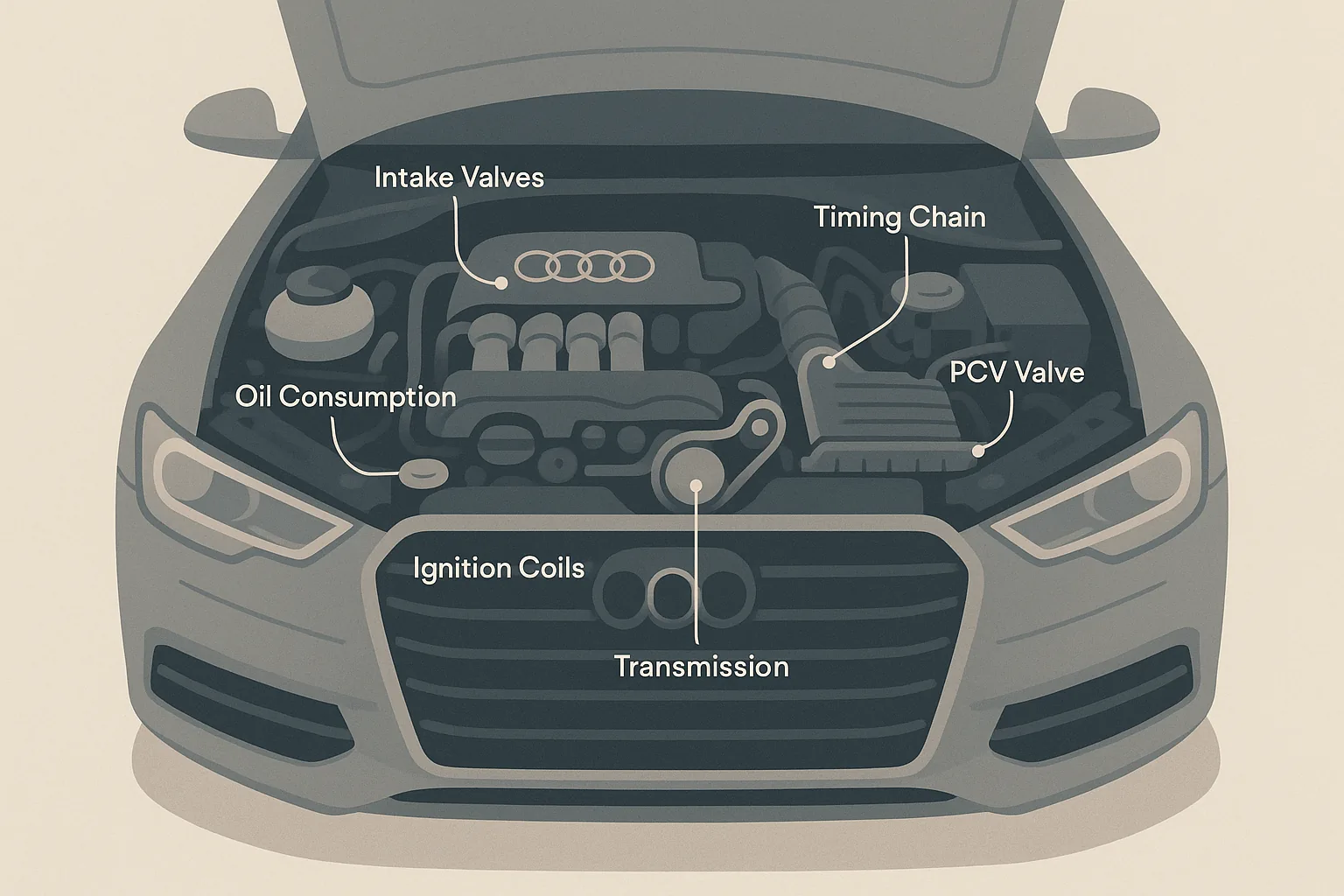
Illustrative overview of where the seven issues live on a typical Audi drivetrain. Your specific model and engine determine which ones apply.
1. Carbon buildup on the intake valves (A4, A6, Q5 direct-injection engines)
Direct-injection engines spray fuel straight into the cylinder instead of over the back of the intake valve. That's great for efficiency, but it means no fuel washes the valves clean. Over time, oil vapor and combustion residue bake onto them as carbon.
You'll usually feel it as a rough cold idle, a slight loss of power, or a stumble under light throttle, most often somewhere in the 80,000 to 120,000 mile window. The fix is walnut-blasting the intake valves, which is a cleaning job rather than a parts replacement. On the 2.0T and 3.0T engines in the A4, A6, and Q5, it's a predictable service you can budget for.
2. Oil consumption on the 2.0T EA888 (A4 and Q5, roughly 2009 to 2014)
The first- and second-generation 2.0T EA888 engine, common in A4 and Q5 models from about 2009 through 2014, is the one owners ask me about most for oil use. The original piston ring design let more oil past than it should, so some of these engines burn oil between changes.
If yours drinks oil, don't guess. The correct first step is a documented oil consumption test so we know the actual rate, not a hunch. From there the answer might be as simple as monitoring and topping up, or it might point to a PCV or ring-related repair. Audi revised the piston and ring design on later versions of the engine, so newer A4 and Q5 models are far less prone to it.
3. Timing chain tensioner failure (early 2.0T A4 and Q5)
This is the one that earns its reputation, and it's worth taking seriously. Certain early 2.0T TFSI engines used a timing chain tensioner that could lose tension over time, and a failed tensioner can let the chain skip. On an interference engine, that risks real internal damage.
The classic warning sign is a rattle from the engine on a cold start that fades after a few seconds. If you hear that on an early A4 or Q5, get it looked at soon rather than waiting. Audi updated the tensioner design on later engines, and on affected cars we can inspect it and replace the tensioner and chain kit before it becomes a catastrophic failure. This is exactly why a proper engine diagnostic with factory-level tools matters, so you fix the real problem instead of throwing parts at a noise.
4. Water pump and thermostat leaks on the 3.0T V6 (A6, Q5, Q7)
The supercharged 3.0T V6 in the A6, Q5, and Q7 relies on a water pump and thermostat assembly that use plastic housings, and those are a well-known higher-mileage replacement. Plastic gets brittle with heat cycles and eventually weeps coolant.
You might spot it as a low-coolant warning, a sweet smell after driving, or a small puddle. Because the 3.0T's cooling components sit in a tight valley on the engine, catching a seep early is much cheaper than dealing with an overheat. When these parts are due, we handle them together so you're not back in a month for the neighboring component.
5. Ignition coil and spark plug wear (all four models, turbo engines)
This is the most universal one on the list. Turbocharged Audi engines run hot and put real load on the ignition coils and spark plugs, and those wear out. It's not a defect, it's a maintenance item, and it hits the A4, A6, Q5, and Q7 alike.
Expect coils and plugs to become a topic somewhere around 60,000 to 90,000 miles, though hard driving shortens that. The symptom is usually a misfire: a rough idle, a flashing check-engine light, or a stumble under acceleration. The good news is it's straightforward and affordable to fix, and running fresh coils and correctly gapped plugs keeps the whole engine happier.
6. PCV valve and crankcase breather failure (2.0T and 3.0T)
The positive crankcase ventilation (PCV) system manages the pressure and oil vapor inside the engine. On both the 2.0T and 3.0T, the PCV valve and breather diaphragm are known to fail as the car ages, and a bad one throws off how the engine breathes.
Symptoms include a rough idle, a whistling or hissing sound, higher oil use, or a check-engine light. A failing PCV can even mimic other problems, which is why it gets misdiagnosed. It usually shows up past 70,000 to 100,000 miles. The part itself isn't expensive, and replacing it often clears up complaints owners assumed were something far worse.
7. Transmission service that gets skipped (S tronic and Tiptronic)
Here's the problem that isn't really the car's fault. Audi's S tronic (DSG) dual-clutch and Tiptronic automatic transmissions both need fluid and, on the DSG, mechatronic and clutch-pack service on a schedule. Because some owners were told these were "sealed for life," the service quietly gets skipped, and skipped fluid is how a healthy gearbox turns into an expensive one.
Signs of a transmission that's overdue include jerky low-speed shifts on a DSG, delayed engagement, or a shudder. The A4, A6, Q5, and Q7 all use one of these units depending on year and trim. Staying on top of the service is one of the highest-value things you can do, and our Audi transmission service keeps these units alive well past the point where a neglected one would fail.
How to stay ahead of these Audi problems
Most of these follow a mileage pattern, so a simple habit keeps you ahead of all seven:
- Get a real inspection once a year or at major mileage marks, so carbon, oil use, cooling seeps, and PCV wear get caught while they're small.
- Do the oil service on time with the correct Audi-approved oil spec, which slows carbon and protects the timing components.
- Never skip transmission service, even if you were told the gearbox is sealed for life.
- Chase noises and warning lights with a proper diagnostic, not a parts-swap guess, especially any cold-start rattle.
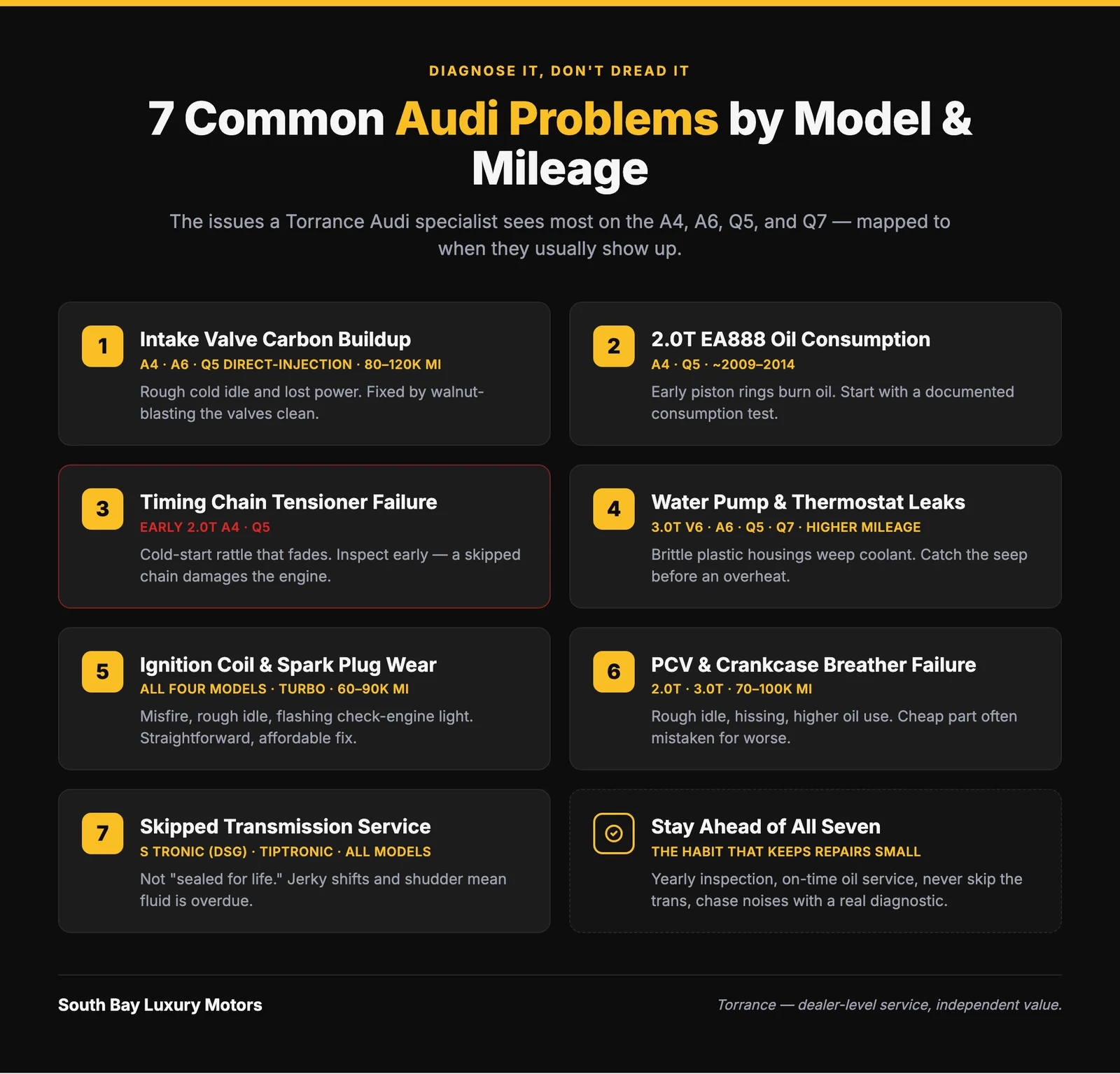
Representative mileage ranges based on what we commonly see. Your car's history, engine, and driving conditions shift the timing.
The bottom line on common Audi problems
An Audi isn't a mystery box. It's a well-built car with a short list of known, mileage-driven items: carbon buildup, 2.0T oil consumption, timing chain tensioners, 3.0T cooling leaks, ignition coils, PCV failures, and transmission service. Handle them on schedule and most stay small.
At Luxury Motors of South Bay in Hermosa Beach, I run the same VCDS and factory-level scan tools the dealer uses, install OEM-quality parts, and inspect before I quote. You get dealer-caliber Audi work without the dealer overhead or the upsell. If you want a straight read on where your A4, A6, Q5, or Q7 actually stands, book an Audi diagnostic or call us at 310-504-0089.
Frequently Asked Questions
What are the most common Audi problems?
The ones I see most across the A4, A6, Q5, and Q7 are carbon buildup on direct-injection engines, oil consumption on the 2.0T EA888, timing chain tensioner failure, water pump and thermostat leaks on the 3.0T V6, worn ignition coils, PCV and valve cover breather failures, and DSG/S tronic transmission service that gets skipped. Most are predictable by mileage, and catching them early keeps the repair small.
At what mileage do Audi problems usually start?
It depends on the item. Ignition coils and PCV issues can show up by 60,000 to 80,000 miles. Carbon buildup, oil consumption, and timing chain tensioner concerns tend to surface between 80,000 and 120,000 miles on affected engines. Water pumps on the 3.0T V6 in the Q5 and Q7 are a known higher-mileage replacement. Regular inspection is how you get ahead of all of them.
Which Audi engine has the oil consumption problem?
The one owners ask about most is the first- and second-generation 2.0T EA888, found in many A4 and Q5 models from roughly 2009 to 2014. Later revisions of the engine improved the piston and ring design. If your car burns oil, the right first step is a documented consumption test, not a guess, so we know what we're actually dealing with before recommending anything.
Is carbon buildup on an Audi expensive to fix?
Walnut-blast intake valve cleaning is a labor job, not a parts job, so the cost is driven by how long the engine takes to access. On most Audi four-cylinder and V6 direct-injection engines it's a predictable, budgetable service, and doing it on schedule is far cheaper than chasing a rough idle or misfire that carbon eventually causes.
Should I use an independent shop for Audi repairs?
For most maintenance and repair, yes. At Luxury Motors of South Bay we run the same VCDS and factory-level scan tools the dealer uses, install OEM-quality parts, and inspect and quote before we touch anything. You get dealer-caliber Audi work without dealer overhead, and federal law protects your warranty when the service is done to spec with the correct parts.
Want a straight answer on what your Audi actually needs? Start with a diagnostic.
Learn more