Ownership and Maintenance
7 Things to Know Before Buying a Used BMW
I'm Shawn Baker, founder and ASE Certified Master Technician at Luxury Motors of South Bay in Hermosa Beach. The question I get most from South Bay drivers shopping around isn't "which BMW is fastest", it's "are these things actually reliable, or am I signing up for a money pit?" So here's the honest answer, and the seven things I'd want you to know before you buy a used BMW.
BMW reliability gets talked about in extremes. One person swears their 3 Series ran 200,000 trouble-free miles; the next swears theirs bankrupted them. Both are telling the truth. The difference almost always comes down to how the car was maintained and whether the buyer knew what to check before handing over the money. Get those right and a used BMW is a genuinely rewarding car to own.
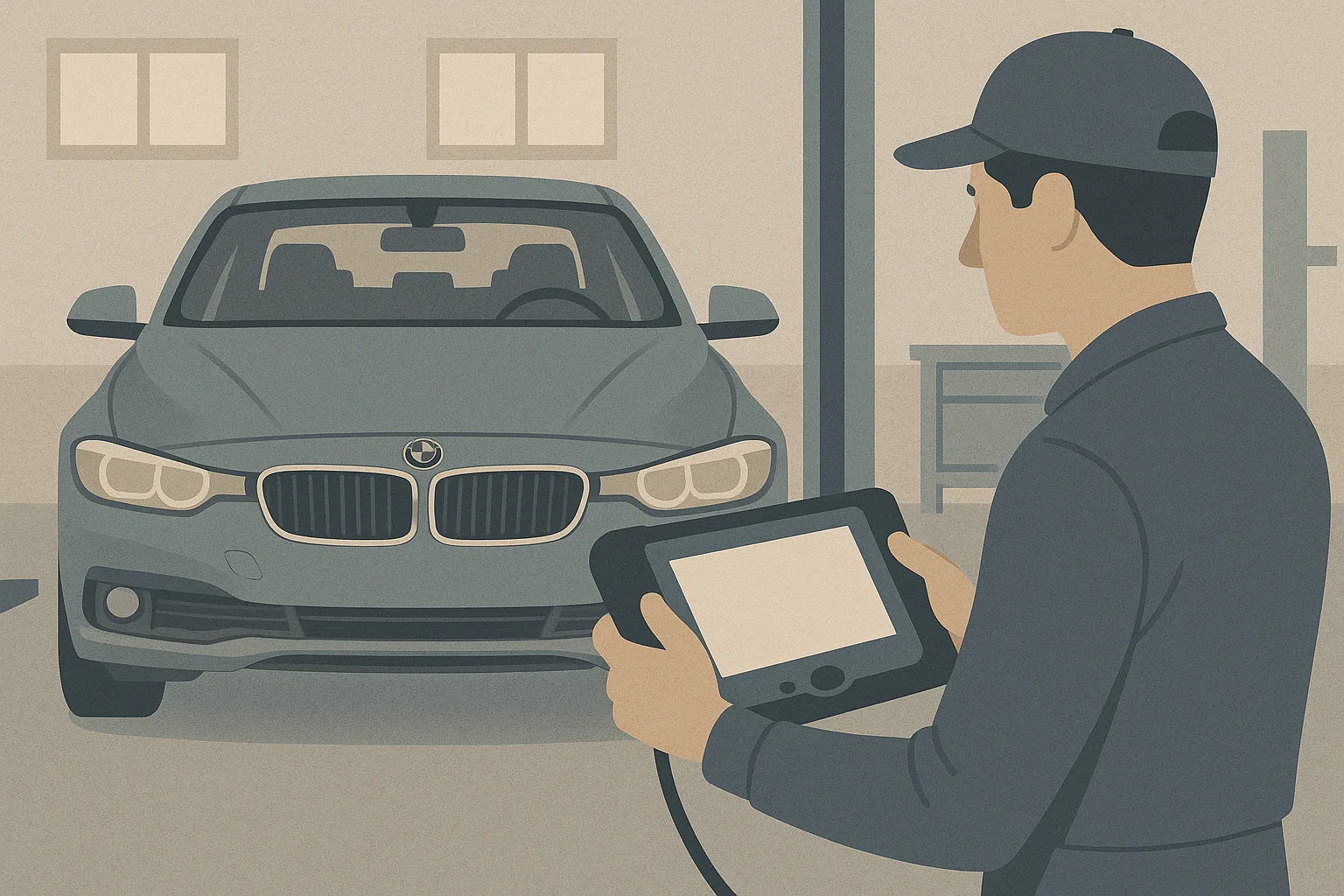
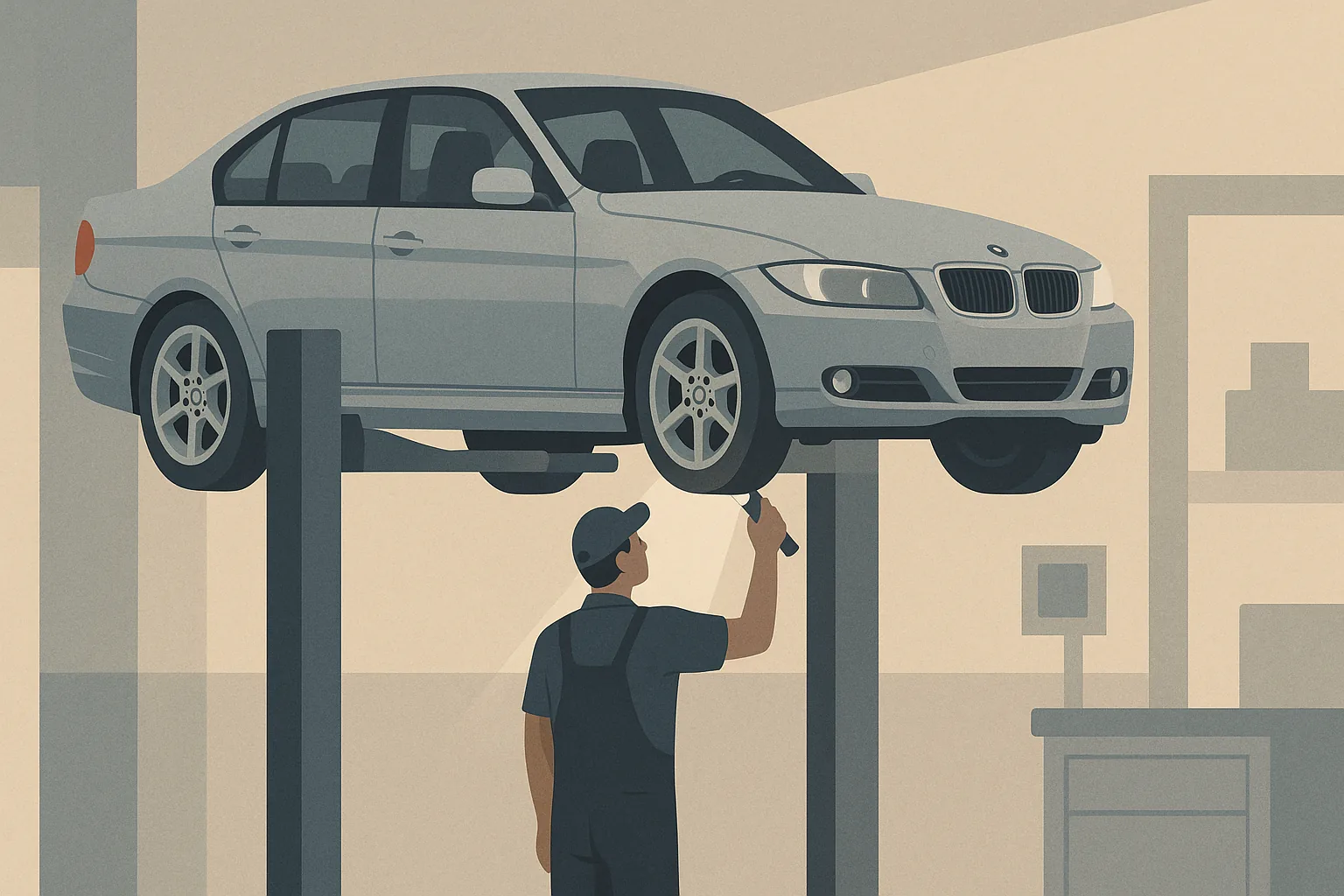
A pre-purchase inspection reads the car's stored data, not just its shine. That's where BMW reliability is really decided.
Are used BMWs reliable, honestly?
A used BMW is reliable when it's been maintained to spec and you buy a documented example, the "money pit" reputation is mostly deferred maintenance catching up to a second or third owner. These are engineered, high-performance German cars, so parts and labor cost more than an economy sedan. But the failures people fear are, with rare exception, well-known items with known fixes, not random gremlins.
Consumer Reports and J.D. Power both rank BMW in the middle of the pack for predicted reliability among mainstream and luxury brands. That's the real picture: not the most trouble-free car you can buy, not a disaster either. What tips a specific car toward reliable or expensive is service history and timing. I've seen 150,000-mile BMWs that are tighter than 50,000-mile ones, purely because someone stayed ahead of the maintenance.
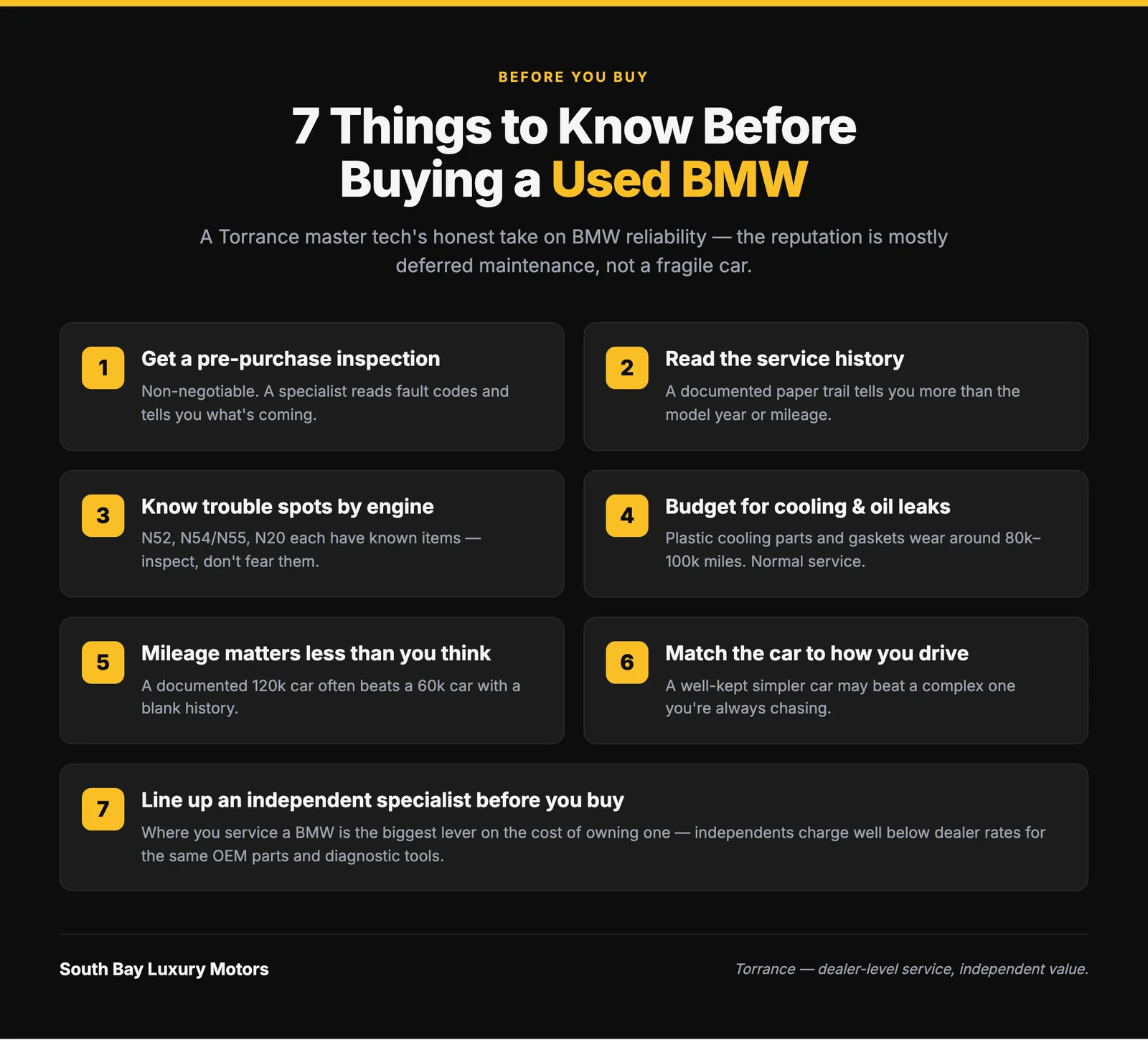
So the goal isn't to find a BMW that never needs anything. It's to buy the right example and go in with your eyes open. Here are the seven things that decide it.
1. Get a pre-purchase inspection before you sign anything
This is number one for a reason. A pre-purchase inspection is the single best money you'll spend, and it's non-negotiable on a used BMW. For a couple hours of shop time, an independent specialist reads the car's stored fault codes, checks it on a lift, and tells you what's coming.
A test drive can't show you a weeping oil-filter-housing gasket or a cooling system on its last legs. Our diagnostic tools can. We plug in the same tier of scan tool the dealer uses, pull the service history off the car's own computer, and give you an itemized list of what's healthy and what needs attention. That list is your negotiating leverage, or your reason to walk.
Never let a seller talk you out of an independent inspection. A clean car has nothing to hide, and an honest seller welcomes it.
2. Read the service history like it's the real price tag
The service records tell you more about BMW reliability than the model year or the mileage. A car with a documented paper trail, oil services on time, cooling work done, receipts to match, is worth paying more for. A car with no history is a question mark you're paying to answer yourself.
What I look for: consistent oil and fluid services with the correct BMW-approved spec, any cooling-system parts already replaced, and no long gaps where the car went years untouched. Gaps aren't automatic dealbreakers, but they tell me what to inspect harder.
If the seller can't produce records, that's not the end of the world. It just means the pre-purchase inspection matters even more, and the price should reflect the unknown.
3. Know the common trouble spots by engine
Different BMW engines have different personalities. You don't need to memorize every code, you just need to know what's normal for the one you're buying so a routine item doesn't scare you and a real problem doesn't slip by.
Representative trouble spots by engine family. Every individual car still comes down to how it was maintained.
Here's the honest rundown on the engines you'll see most in the South Bay:
- N52 (naturally aspirated inline-six): One of the longest-lived BMW engines. Watch the plastic cooling parts and the valve-cover and oil-filter-housing gaskets as it ages. Fewer surprises overall.
- N54 / N55 (turbocharged inline-six): Strong, tunable engines with more to budget for, cooling parts, gaskets, and on the earlier N54, the fuel injectors and high-pressure fuel pump are known items.
- N20 (turbo four-cylinder): Great daily-driver power, but the timing chain and guides on earlier examples are worth confirming during inspection.
None of these are reasons to avoid a car. They're reasons to inspect it properly and price it fairly. A well-maintained turbo will outlast a neglected naturally aspirated car every time. We cover the full list on our common BMW problems page if you want the deeper detail before you shop.
4. Budget for the cooling system and oil leaks
If you take one maintenance fact away, make it this: BMW cooling systems use a lot of plastic, and those parts have a service life. Thermostat housings, water pumps, and expansion tanks are among the most common replacements, especially as a car crosses 80,000 to 100,000 miles.
Oil leaks are the other classic. Valve-cover gaskets and oil-filter-housing gaskets weep on higher-mileage cars. Caught early, they're a manageable gasket job. Ignored, they make a mess and can leak onto belts or components. Neither of these means a bad car, they mean a BMW old enough to need normal service.
When you're buying, ask whether these have already been done. If the cooling system was refreshed recently, that's money you don't have to spend. If it hasn't, factor it into your offer.
5. Mileage matters less than you think
A used BMW's odometer reading is one of the weakest predictors of how reliable it'll be. I'd take a 120,000-mile car with full records and recent cooling work over a 60,000-mile car with a blank history most days of the week.
High mileage often means highway miles and a driver who stayed on top of service, the easiest life a car can have. Low mileage can hide a car that sat, went years between oil changes, or got short-trip city driving that's harder on everything. The inspection and the records tell the real story; the number on the dash doesn't.
Don't rule out a higher-mileage BMW on principle. Rule out a poorly maintained one, at any mileage.
6. Match the car to how you'll actually drive
Be honest about your commute and your patience for maintenance. A turbocharged M-Sport car is a thrill, but it has more systems to maintain than a base model. If you're daily-driving the 405 in stop-and-go traffic, a simpler, well-kept car may make you happier than a complex one you're always chasing.
South Bay traffic also wears brakes and tires faster than a highway-cruise number suggests. That's true of any car, but it's worth planning for on a performance BMW with bigger, pricier brakes. None of this is a reason to buy less car than you want, it's a reason to buy the right car for your real life.
The best BMW to own is the one whose upkeep fits your budget and your driving, not the one with the biggest number on the spec sheet.
7. Line up an independent specialist before you buy
Where you service a BMW is the biggest lever you control over the cost of owning one. An independent specialist typically charges well below dealer rates for the same OEM-quality parts and the same tier of diagnostic tools. Knowing you have that shop lined up changes the math on the whole purchase.
Federal law protects your warranty as long as maintenance is done to specification with the correct parts, so using an independent shop for routine work doesn't put a factory warranty at risk. When you own the car, staying ahead of the BMW maintenance schedule and catching known items early with a proper engine diagnostic is what keeps a used BMW firmly in the reliable column.
At Luxury Motors of South Bay, we inspect first, quote you an itemized estimate, and only do the work you approve. That's the relationship that makes BMW ownership predictable instead of stressful.
The honest bottom line on BMW reliability
A used BMW is as reliable as its maintenance and your homework. The cars aren't fragile, and the scary bills people talk about are mostly known items caught too late by owners who skipped the inspection or bought without records. Do the opposite and you get a genuinely great car.
Buy a documented example, get an independent pre-purchase inspection, know the trouble spots for your engine, and budget for cooling and gasket work as the car ages. If you're weighing a specific used BMW in the South Bay, call us at 310-504-0089 or bring it by for a pre-purchase inspection before you commit, I'd rather you know what you're buying than find out after.
I'm Shawn Baker, founder and ASE Certified Master Technician at Luxury Motors of South Bay in Hermosa Beach, and a Marine Corps veteran. I've spent my career diagnosing and servicing Porsche, Audi, Mercedes-Benz, and BMW with dealer-level tools, and I inspect used BMWs for South Bay buyers every week.
Frequently Asked Questions
Are used BMWs reliable?
A used BMW can be very reliable if it was maintained on schedule and you buy a good example. The reputation for high repair bills usually comes down to deferred maintenance and known items caught late, not the car being fragile. The single best predictor of a reliable used BMW is a clean, documented service history plus a pre-purchase inspection before you sign.
What should I check before buying a used BMW?
Check the service records, run the VIN for accident and title history, and pay for an independent pre-purchase inspection with dealer-level scan tools. The inspection reads stored fault codes, checks for cooling and oil leaks, and confirms the car is not hiding a known problem the seller cleared before your test drive.
Which used BMW engines are the most reliable?
Naturally aspirated inline-sixes like the N52 have a strong track record for longevity, though they still need cooling-system attention. Turbocharged N54 and N55 engines make great power but have more known items to budget for. The engine matters less than how the specific car was maintained, a well-serviced turbo beats a neglected naturally aspirated car.
How many miles is too many for a used BMW?
Mileage matters far less than maintenance. A 120,000-mile BMW with full records and recent cooling and gasket work is often a safer buy than a 60,000-mile car with no history. Judge the car by its documentation and inspection results, not by the odometer alone.
Is it worth getting a pre-purchase inspection on a used BMW?
Yes. A pre-purchase inspection is the cheapest insurance you can buy on a used BMW. For the cost of a couple hours of shop time, you find out about pending cooling, oil-leak, or suspension work before you own it, which gives you real numbers to negotiate with or a reason to walk away.
Thinking about a specific used BMW? Bring it in for a pre-purchase inspection first.
Learn more